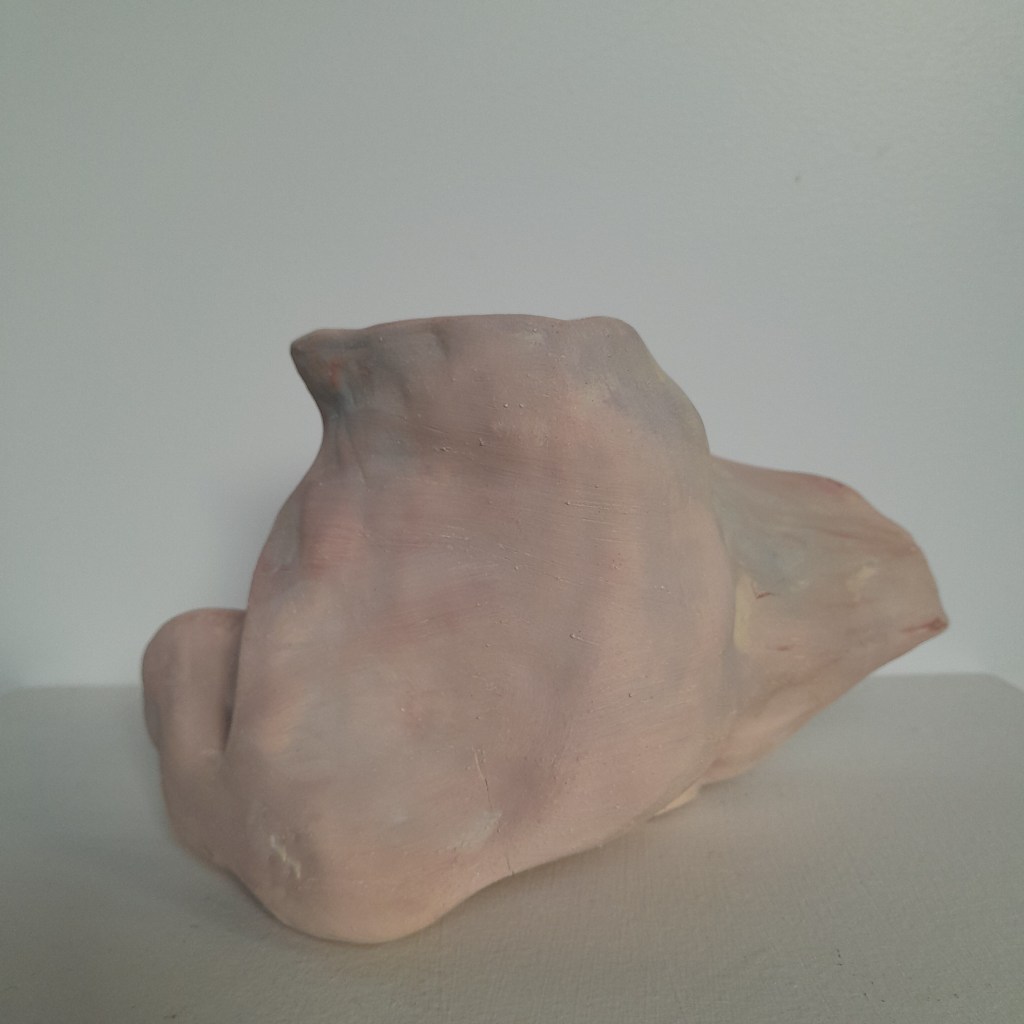
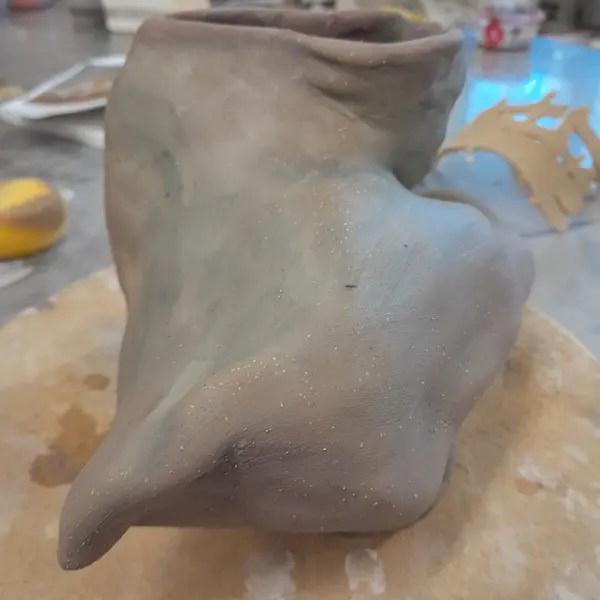
Emma Rochester Part of Me is Missing, Fleshy, Dusty, Amorphous, Raw clay and oxides.
Part of Me Is Missing
Part of Me Is Missing
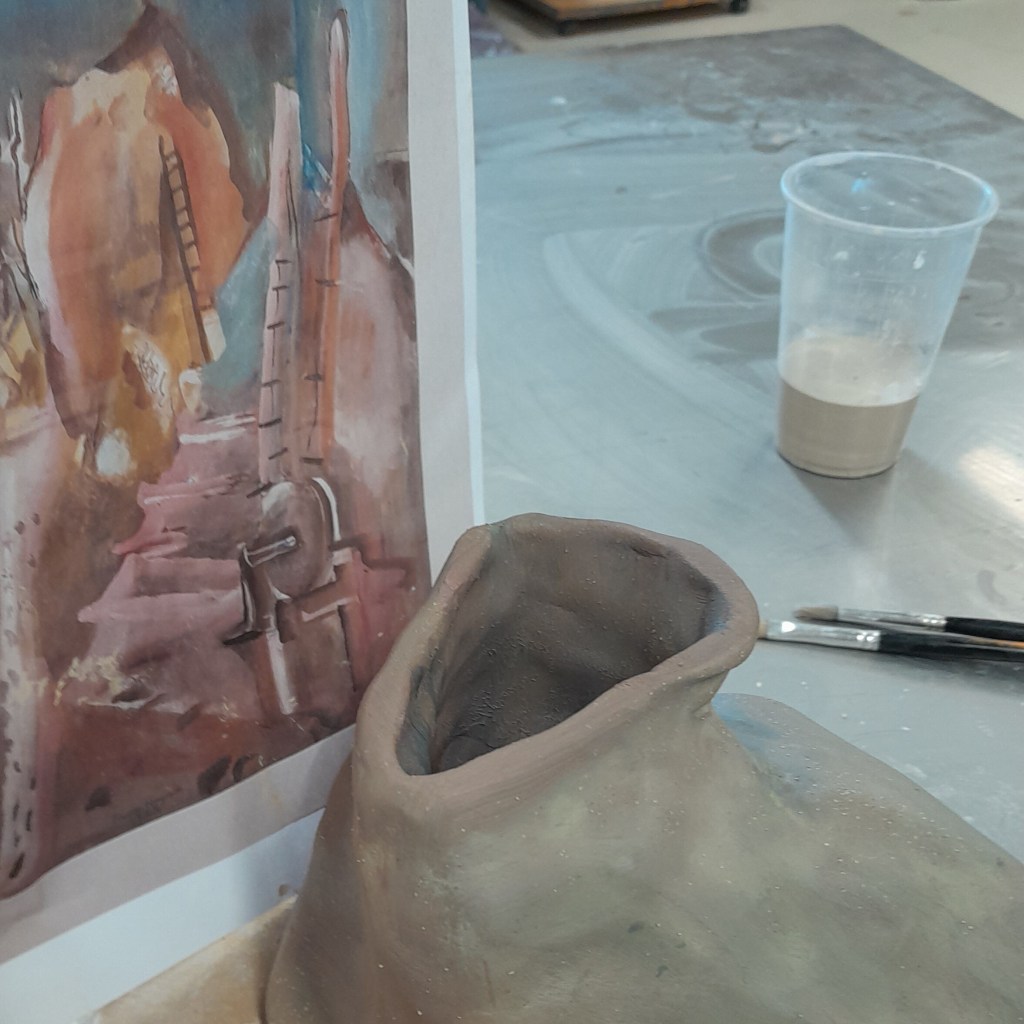
It was the soft pinks in Frances Hodgkins’ The New Rick that first drew me towards the painting (circa 1933). Those tender, dusty colours, the uncertain edges of things, as though the familiar shapes of the farm had begun to surrender themselves to memory. As if the farm machinery were beginning to rust a salmon pink, the colour of abandonment, or the colour of a honeydew Indian Summer sunset. It wouldn’t be for several year until the wartime era hit and then the war would draw on and no one came to till the land.
In The New Rick, Hodgkins depicts something of her everyday surroundings. I imagine her wandering around her makeshift home in Britain, a different pastoral field from those she would have known growing up in Otago, New Zealand.
I imagine her towards the end of her life, in garments muddied with paint marks, wrapped in as many winter woollies as she can muster around the slight rack of her shoulders. Outside in the fresh air, she looks down at her hands and notices the age of herself and things. The weathering of time, the lines impressed upon her.
Perhaps she sees a life that was not as she had imagined it would be, but one that was wilder and infinitely more boundless than she could have hoped. Australia, Paris, New Zealand, and all the small adventures and longer journeys that may have occurred but were never recorded in a letter or photograph. In Wales, perhaps, she had found herself swayed by the mystical, but in England she passed beyond.
I thought of Hodgkins herself in front of the painting. Situated with colour and easel in the grim English weather, so far from the New Zealand of her childhood, yet with that same shared feeling of rain and the joy when light emerges from behind a cloud.
I was drawn to the bareness of it all. Her finding a place to live through the privations of wartime Britain. Rations and food shortages, and no one with the spare cash to buy paintings. Gone was her physical nourishment, but potentially so too was her sense of meaning. Her chance to meet with other painters and students, to discuss the potential and possibility of fields of colour. All drained by the processes and strategies of war.
Instead, parcels arriving from Aotearoa across the sea, tins of sardines tucked inside as small offerings from her distant home. There was no one close enough to feed her, but perhaps a shiny fish in a can might tide her over, or tide her away.
I imagined the cold, the loneliness, the thinness of things, the glint of the sardine tin lid, and an admiration for the industriousness of the tin pulley. But most of all, for the farm ladder leading ever upwards, towards something just beyond reach.
Like ivy clinging to the brickwork of a British home, perhaps she too wished to cling to a life so far removed from the familiar daily routines and rituals of ordinary New Zealand life.
Maybe there was the romance of New Zealand but no real wish to return. Perhaps New Zealand had become more beautiful in its absence, its remembered landscapes aggrandised by distance and time. Or perhaps the damp fields and pale skies of Britain had quietly become her home.
Who can say where a person truly belongs, or when the place we leave behind becomes a place we can no longer return to?
In the painting’s soft, fleshy colours I found something of this uncertainty. An underbelly, tender and exposed, where the boundaries between landscape, body and memory seemed to dissolve.
As if she herself were floating along, watching herself wrapped in newspaper, alone on the floor, longing for the sunshine to pour in. And when the sunlight danced in the dusty tendrils of the air, she could float out through the farmhouse window, across green paddocks, and admire the orderliness of life despite the chaotic messiness of her own.
Part of Me Is Missing reflects upon the things we carry away with us and the things we leave behind. How memory softens the edges of a life until even the distance between here and home becomes difficult to measure. A form can emerge from a feeling, and how a visual impression might find its way into the material world.
Whilst The New Rick was painted years before her death, it belonged to a landscape not so far removed from the place where I imagine her lying upon cold floorboards, wrapped in sheets of newspaper imprinted with stories from afar.
Something local, something filled with stories, like raw clay and oxides gathered into a hollow, irregular form. Something bodily, something weathered, something not quite able to hold itself together. Something not quite able to be contained within the page.
As if Hodgkins were gently emerging from the frame, finding a way back home.

